


Overview
- On 28 February 2026, the US and Israel launched Operation Epic Fury against Iranian military and civilian targets, killing 787 people as of 03 March.
- The ongoing operations have prompted extensive Iranian retaliation, with the country’s security forces firing over 1,000 missiles and UAVs (Unmanned Aerial Vehicles or drones) targeting US, Israeli and Gulf ally assets as of 02 March.
- Up to eight commercial vessels were struck or affected between 28 February – 02 March in the Strait of Hormuz, Gulf of Oman, and Persian Gulf, resulting in two fatalities and multiple injuries, with targeting patterns remaining unpredictable across multiple flag states.
- An Islamic Revolutionary Guard Corps (IRGC) commander announced on 02 March that the Strait of Hormuz is closed, threatening to “set ablaze” any vessel attempting passage. Commercial shipping through the Strait has effectively halted, with at least 150 tankers anchored in open Gulf waters as of 02 March.
- Major carriers including Maersk, CMA CGM, and Hapag-Lloyd have suspended Strait of Hormuz transits, with vessels rerouting around the Cape of Good Hope adding 10-14 days to journey times.
Recent Key Developments
On 28 February 2026, the United States (US) and Israel launched Operation Epic Fury, conducting coordinated strikes against Iranian military targets including Islamic Revolutionary Guard Corps (IRGC) command facilities, missile and drone launch sites, air defence systems, and military airfields. The operation targeted facilities across multiple Iranian provinces, with US Central Command (CENTCOM) reporting successful strikes on naval bases, weapons installations and depots, and security facilities. During the first day of the operation, Iran’s Supreme Leader, Ayatollah Ali Khamenei, was killed in an airstrike on his offices in Tehran.
Within hours of the initial strikes, Iran initiated retaliatory operations across a wide geographic area spanning the Persian Gulf, Gulf of Oman, Red Sea approaches, and multiple Gulf state territories. By 02 March, Iran had launched over 830 unmanned aerial vehicles (UAVs) and 370 missiles targeting US military assets, energy infrastructure, and civilian targets in Israel, Qatar, Kuwait, the United Arab Emirates (UAE), Bahrain, Saudi Arabia, Iraq, and Oman. The strikes destroyed or damaged military facilities, port infrastructure, and in multiple cases, struck civilian vessels and commercial port areas.
Strait of Hormuz
On 02 March, an IRGC commander announced via Iranian state media that the Strait of Hormuz is “closed” and warned that Revolutionary Guard and regular navy forces would “set ablaze” any vessel attempting passage. While this does not constitute a formal legal closure, the combination of kinetic attacks on commercial vessels, sustained GPS jamming across Gulf waters, and explicit Iranian threats has created conditions where commercial operators have largely halted movement or withdrawn from the region. As of 02 March, vessel tracking data showed at least 150 tankers anchored in open Gulf waters outside the Strait, with major shipping lines suspending bookings and ordering vessels to shelter pending further assessment.
Attacks on Commercial Vessels
- 28 February: Unconfirmed reports indicate a projectile struck the UAE-flagged cargo ship LTC Ayeh near Zirko Island, approximately 70NM northwest of Abu Dhabi, UAE, Persian Gulf. The vessel was damaged by shrapnel and one crew member was killed.
- 01 March: A projectile struck the Marshall Islands-flagged tanker MKD Vyom approximately 52NM offshore Muscat, Oman, Gulf of Oman. One crew member was killed in a subsequent fire and explosion on the vessel. Unconfirmed reports indicate the weapon used was an unmanned surface vehicle (USV).
- 01 March: A projectile struck the Palau-flagged tanker Skylight, approximately 5NM north of Khasab port, Oman, Strait of Hormuz. Four crew members were injured and 20 personnel were evacuated. The perpetrator remains unknown; Skylight was on the US sanctions list and was allegedly struck by Iran.
- 01 March: A projectile struck the Gibraltar-flagged tanker Hercules Star approximately 14-20NM northwest of Mina Saqr, UAE, Persian Gulf. The projectile caused a fire, which was subsequently extinguished, and the tanker continued its course. No injuries were reported.
- 01 March: A projectile struck the Liberia-flagged tanker Ocean Electra (possibly not a direct hit or landing in close proximity) approximately 35NM west of Sharjah, UAE, Persian Gulf. No injuries were reported.
- 01 March: Unconfirmed reports indicate Iran attacked the Liberian-flagged tanker Sea La Donna west of Dubai, UAE, Persian Gulf. Damage and location details still emerging.
- 02 March: Two projectiles struck the US-flagged tanker Stena Imperative, anchored in the Port of Bahrain in the Persian Gulf, causing a fire which was subsequently extinguished. Falling debris from an intercepted projectile killed one shipyard worker.
- 02 March: Two UAVs struck the Honduras-flagged tanker Athe Nova offshore Khor Fakkan, UAE waters, Persian Gulf, causing a fire. Iranian media reported that the vessel was providing fuel to US Navy ships, though maritime tracking data shows it has operational history at Iranian terminals.
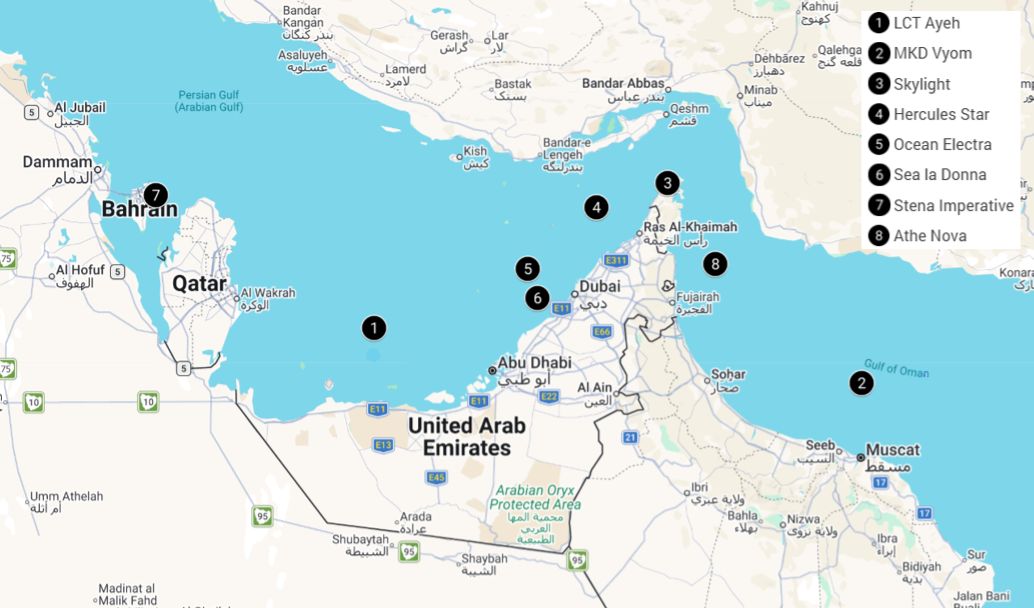
Please note locations are based on available intelligence and emerging information may be released updating incident details.
Notable Iranian Attacks on Port Infrastructure:
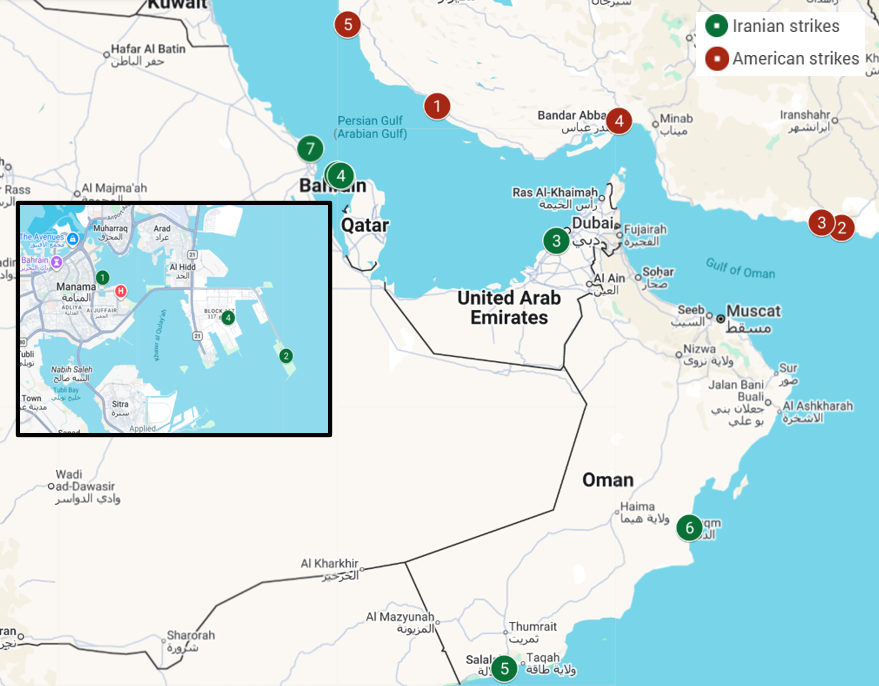
- 28 February: Iran struck the headquarters of the US Navy’s Fifth Fleet in Manama, Bahrain, with missiles and drones, destroying several structures.
- 01 March: Bahrain’s Ministry of Interior reported that Iran had targeted a maritime facility near the Mina Salman port in the capital, Manama.
- 01 March: Iran struck a fenced recreational area at Jebel Ali Port in Dubai, UAE. The port is not an official US base but is frequently used by the US Navy as a port of call.
- 01 March: Bahrain intercepted a missile, with falling debris causing a fire on a “foreign ship” in the Salman industrial zone, Bahrain.
- 01 March: Iran reportedly launched strikes at Salalah Port, Oman. Damage is unknown.
- 01 March: Iran struck Duqm commercial port, Oman, with two UAVs, injuring one worker. Debris from a downed drone fell near fuel tanks in a separate area of the port, but no casualties or damage were reported.
- 02 March: Saudi Arabia intercepted two drones at the Ras Tanura oil refinery, with falling debris causing a limited fire. No injuries were reported, but the refinery was closed.
Notable US-Israeli strikes on Iranian Port Infrastructure:
- 28 February: United States airstrikes destroyed infrastructure at Asaluyeh Port.
- 01 March: United States airstrikes reportedly destroyed an Iranian vessel and several buildings at Chabahar Naval Base.
- 01 March: United States airstrikes destroyed an unconfirmed number of vessels and buildings at Konarak Naval Base. The White House cited President Trump indicating US forces had destroyed nine Iranian vessels in airstrike operations.
- Night of 01-02 March: NASA FIRMS satellite imagery showed fires burning on Bandar Abbas Port after possible airstrikes.
- 03 March: Iranian media reported explosions from US-Israeli airstrikes in the port city of Bushehr.
Assessment
Commercial vessels in the Gulf of Oman, Strait of Hormuz and Persian Gulf face a critical risk of attack from UAVs, missile systems and other weapons in the short term. Iran has demonstrated intent to target tankers regardless of flag state or cargo, with strikes affecting Marshall Islands, Palau, Gibraltar, Liberia, Honduras, and US-flagged vessels. Targeting patterns remain unpredictable, as evidenced by the strike on Athe Nova, a Honduras-flagged vessel with operational history at Iranian terminals that Iranian media claimed was “acting in unison with America.” The Skylight strike similarly demonstrates targeting ambiguity, with the Palau-flagged vessel appearing on US sanctions lists yet allegedly struck by Iran, though the US has not claimed responsibility for the strike. The use of naval mines, which has not been confirmed as of 03 March, would be similarly indiscriminate in targeting. Indeed, the Joint Maritime Information Centre (JMIC) assessed that all Iranian attacks should be considered indiscriminate, that attacks are “almost inevitable”, and that vessels should not attempt transit.
The threat environment may expand significantly at short notice if Houthi forces resume Red Sea, Bab al-Mandeb and northern Arabian Sea operations in response to US-Israeli strikes on Iran. On 28 February, the Iran-aligned Houthis signalled that they would resume missile and drone attacks on shipping routes, ending a months-long period of relative calm since November 2025. The group has employed a range of weaponry, including one-way UAVs, USVs, unmanned underwater vehicles (UUVs), cruise and ballistic missiles, small arms fire, and vessel seizures, with previous targeting expanding beyond Israeli- and US-linked vessels to ships sailing under other national flags. This creates dual-threat scenarios where commercial operators face further constrained routing options, with both Suez Canal approaches via the Red Sea and Strait of Hormuz presenting elevated threat environments simultaneously.
The Gulf of Oman, Strait of Hormuz, Persian Gulf, and very likely the Red Sea shipping lanes, are becoming commercially unviable for the conflict’s duration, requiring route diversions that add 10-14 days transit time and remove capacity from global shipping systems. Major carriers including Maersk, MSC Group, CMA CGM, Hapag-Lloyd, COSCO, and Emirates SkyCargo have restricted or halted bookings through the Strait of Hormuz region as of 02 March. Hapag Lloyd suspended all Strait of Hormuz transits, while CMA CGM ordered vessels inside or bound for the Gulf to proceed to shelter pending reassessment. Rerouting around the Cape of Good Hope adds considerable delays to delivery schedules, effectively removing vessel capacity as ships spending additional time at sea cannot service other routes. The US Maritime Administration has established a 30 nautical mile standoff zone around military vessels, further complicating navigation in congested Gulf waters. The Strait’s role as passage for one-fifth of global oil supply and key commodities including aluminium, sugar, and fertilizer means disruption extends beyond energy to broader supply chains affecting automotive, electronics, pharmaceuticals, and temperature-controlled goods dependent on just-in-time delivery systems. President Trump has indicated the conflict could last four to five weeks but may extend “far longer,” suggesting prolonged disruption to global shipping lanes and sustained economic impact.
About Castor Vali Security Information Services
This deep dive forms part of Castor Vali’s wider maritime intelligence and risk monitoring capability. While this report provides detailed analysis of the current crisis and its implications for commercial shipping, our ongoing monitoring ensures that clients receive timely, operationally relevant updates as situations evolve.
Our maritime risk monitoring product is designed to keep clients informed of emerging threats, including piracy, terrorism, state-based conflict, sanctions exposure, and wider geopolitical developments affecting offshore operations. Through continuous analysis of maritime activity and regional dynamics, we deliver strategic insight that supports informed decision-making and the effective deployment of protective measures for vessels, crew, and commercial interests.
Maritime subscriptions provide access to:
- Maritime Flash Alerts – produced for all offshore areas globally and offered free of charge as part of our ongoing support to the maritime industry and seafarers.
- Maritime Weekly Reports – a structured review of key incidents across West Africa, the Indian Ocean high-risk areas, Southeast Asia and the Americas, supported by analysis, forecasts and visual data.
- Maritime Deep Dives – detailed, topic-specific assessments examining evolving threats, regional developments and strategic risk trends.
We welcome enquiries from operators, insurers, charterers and maritime stakeholders seeking to strengthen their situational awareness. Complimentary trials are available for organisations wishing to evaluate the service.
To receive our free Maritime Flash Alerts, please complete the sign up form below.
Maritime Flash Alerts
Clients interested in receiving our free maritime flash reports should complete this form:

