


The opposition coalition, C64, has called for nationwide demonstrations on 15 September. In the capital city, Kinshasa, protests are expected to converge on the Palais du Peuple (the seat of Parliament) just as lawmakers open their second ordinary session of the year.
C64 wants Parliament to drop the controversial Referendum Bill, which President Félix Tshisekedi sent back on 10 August for a new reading that would incorporate the Constitutional Court’s observations. Despite Tshisekedi proposing a three-month National Dialogue in late August, C64 has confirmed this week’s protests. On 03 September, the coalition urged Congolese to mobilise “in defence of the republican pact”, its term for the existing constitutional order, and in opposition to any change that could open a third term.
How did we get here?
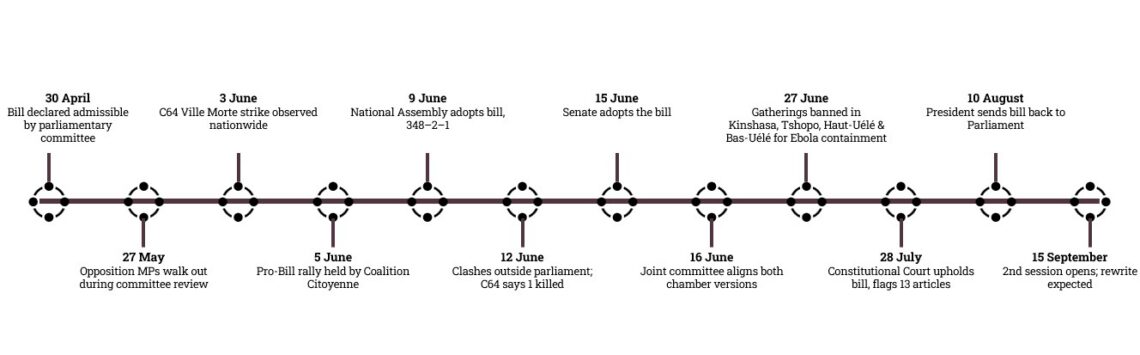
The dispute traces back to 30 April 2026, when a parliamentary committee declared admissible a bill setting out procedures for the hosting of a national referendum, including on a new constitution. While opposition MPs walked out on 27 May during examination of the committee report, the National Assembly adopted the text on 09 June (348–2–1) despite their absence. The Senate subsequently voted on 15 June, and a joint committee aligned the two versions on 16 June.
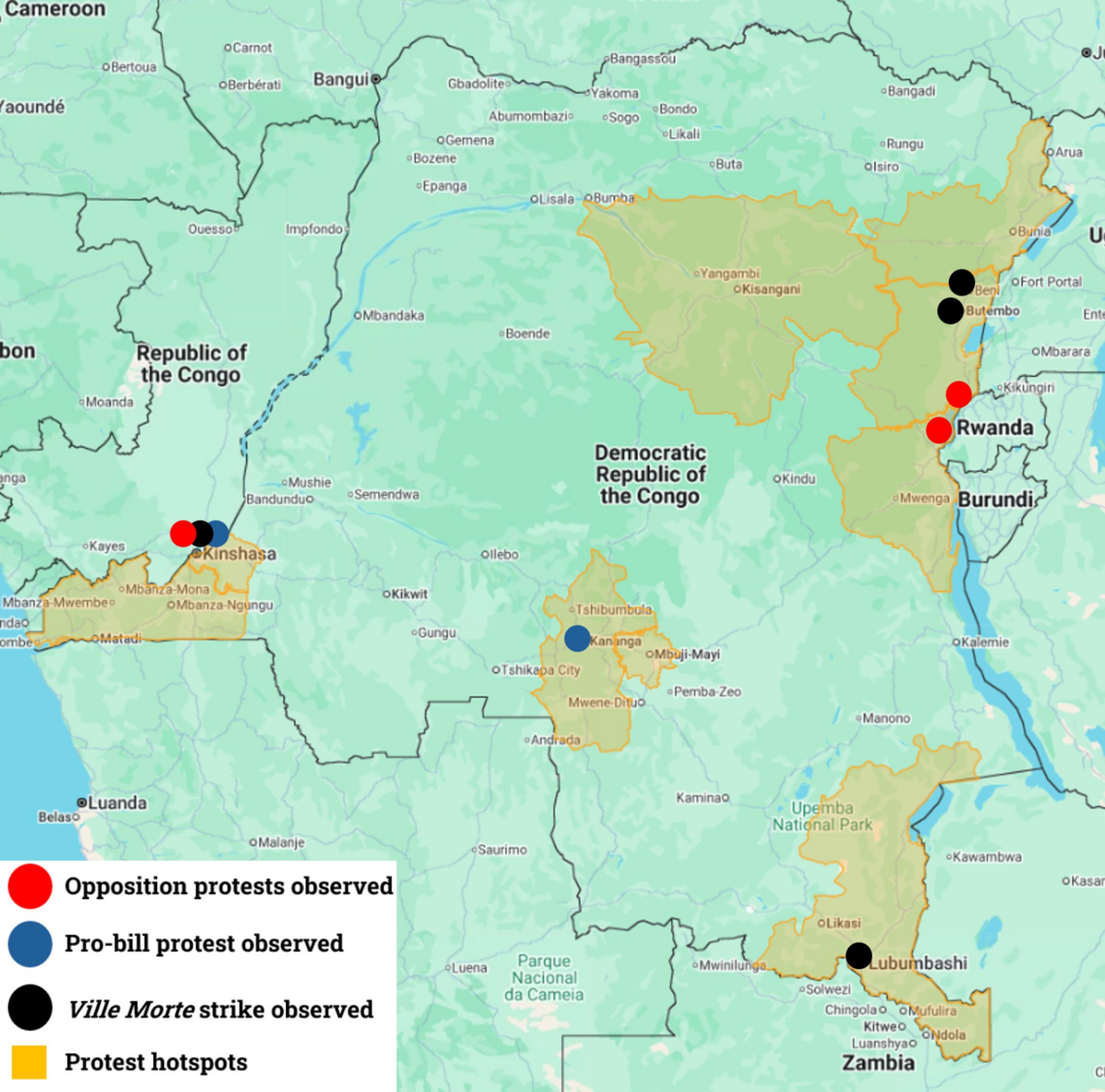
The first set of major protests occurred in early June when C64 called a nationwide Ville Morte (general shutdown/strike) on 03 June, which was widely observed in the capital Kinshasa, Lubumbashi (Haut-Katanga Province), and Beni and Butembo (North Kivu Province). A rival pro-Bill mobilisation, organised by the Coalition Citoyenne pour la Nation (CCN), was held days later on 05 June. Tensions escalated on 12 June, when an opposition sit-in outside Parliament clashed with pro-government activists and police. Opposition figures, including Martin Fayulu and Prince Epenge, were injured, and C64 said at least one demonstrator was killed – although authorities denied this.
In response to this initial outbreak of unrest, on 27 June the government banned public gatherings in Kinshasa, Tshopo, Haut-Uele, and Bas-Uele, reportedly for Ebola containment. The ban was imposed before a planned 08 July C64 opposition march, which subsequently did not proceed. However, pro-Bill protests have been allowed to proceed since. Gatherings and political meetings also remain separately banned in Lubumbashi and Likasi, in Haut-Katanga, with local authorities citing public order and safeguarding social calm.
In the weeks that followed, President Tshisekedi referred the adopted law to the Constitutional Court, which on 28 July upheld it subject to reservations on 13 articles. On the same day, thousands protested against the bill in the M23-held towns of Goma (North Kivu) and Bukavu (South Kivu). On 10 August, the president sent the bill back to parliament for a fresh reading.
Parliament’s second ordinary session, opening on 15 September, is where that rewrite is expected, and further protests are planned.
What does the bill aim to achieve
The current constitution, adopted in 2006 shields certain provisions from revision, including the two-term presidential limit. It also bars any constitutional revision during a state of siege (state of emergency) or war. Notably, eastern DRC is currently facing multiple conflicts, including the M23 rebellion in North Kivu and South Kivu, the Islamic State Central Africa Province (ISCAP)-linked Allied Democratic Forces (ADF) insurgency in Ituri and North Kivu, and sustained violence by other militias across North Kivu, South Kivu, Ituri, and parts of Haut-Uele, Tanganyika, and Haut-Katanga. Both Ituri and North Kivu have remained under a state of siege since May 2021, under which all civilian authority has been handed over to the Armed Forces of the DRC (FARDC) and the police.
The current constitution has no procedure for replacing itself outright. The Referendum Bill would create one, with a legal pathway to put an entirely new constitution to a popular vote, rather than amend the existing one. Because the current one’s clauses do not bind a new constitution, opponents argue this is a workaround to reset Tshisekedi’s term count. The government, for its part, has framed it as institutional reform, arguing the current constitution is outdated.
Will the Bill pass and will the 15 September demonstration happen?
The bill has already cleared parliament and the Senate once, survived Constitutional Court review, and has the president’s public backing — he has said he would accept a third term “if the people wish it.” With the ruling coalition controlling parliament, the pending step is a technical rewrite of the flagged 13 articles, not a fresh vote on the underlying idea. Passage after the September session remains the likely outcome.
The 15 September demonstrations against the bill are therefore likely to proceed and are expected to carry a heightened risk of violence in hotspot areas. Notably, authorities are likely to invoke the gathering ban, as they did in June and July, which carries a risk of clashes.
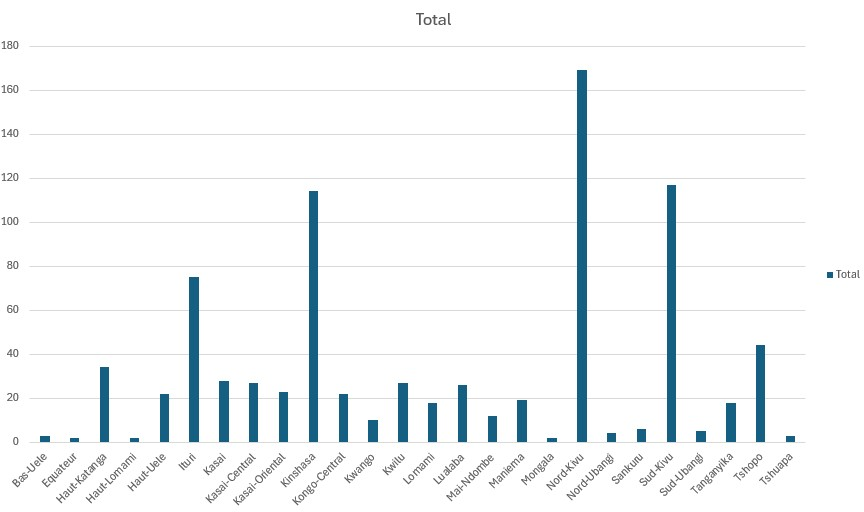
Protest and strike hotspots and risks
- Kinshasa (Gombe and Lingwala): The main hotspot. Expect opposition sit-ins at the Palais du Peuple, with violence.
- Haut-Katanga (Lubumbashi): An opposition stronghold where strikes and protests are possible, though violence is not the base case.
- North Kivu (Goma) and South Kivu (Bukavu): Anti-Kinshasa protests have already occurred, led by the M23 and activists. Beni and Butembo have a history of activism, including Ville Morte strikes.
- Kasai-Oriental (Mbuji-Mayi) and Tshopo (Kisangani): Secondary candidates for Ville Morte strikes and have a history of both peaceful and violent protests over political disputes, insecurity and working conditions.
- Kongo Central, Kasai Central, Kwilu, and Maniema: Government-leaning provinces with low opposition strike uptake. While pro-Bill street protests have not materialised here, there is a possibility these may occur.
- Ituri: This is not a referendum flashpoint unless a call to protest is issued. There is a high protest risk generally tied to insecurity and Ebola containment measures.
What impacts can be expected?
The immediate impact of the strike and protests will likely be economic as observed during the 03 June Ville Morte strike that shut down schools, markets, and transport across Kinshasa and other cities for a day. In the capital, opposition protests will likely be dispersed by the police, resulting in roadblocks and clashes with the protesters. In Kinshasa, pro-government supporters have also targeted and damaged opposition convoys and offices, and assaulted opposition figures, during previous protests in Kinshasa. Similar protests and disruptions could materialise in other regions, with clashes with security forces.
Risk Intelligence Service Trial
Clients interested in trailing our subscription packages should complete this form: